

Melanoma is one of the most serious forms of skin cancer, but early detection and treatment can significantly improve outcomes. At City Dermatology Skin Institute, we provide comprehensive melanoma screening, diagnosis, and treatment for patients throughout Bensalem, Bucks County, and the surrounding Philadelphia area. Led by Imran Amir, MD, FAAD, a board-certified dermatologist with over 20+ years of dermatology experience and fellowship-trained Mohs surgeon, our team is dedicated to helping patients identify melanoma early and receive advanced, personalized care.
While melanoma is less common than other types of skin cancer, it has a greater potential to spread to other parts of the body if left untreated. That’s why regular skin examinations and prompt evaluation of suspicious moles are essential.
Early Melanoma Detection and Skin Cancer Screening in Bensalem
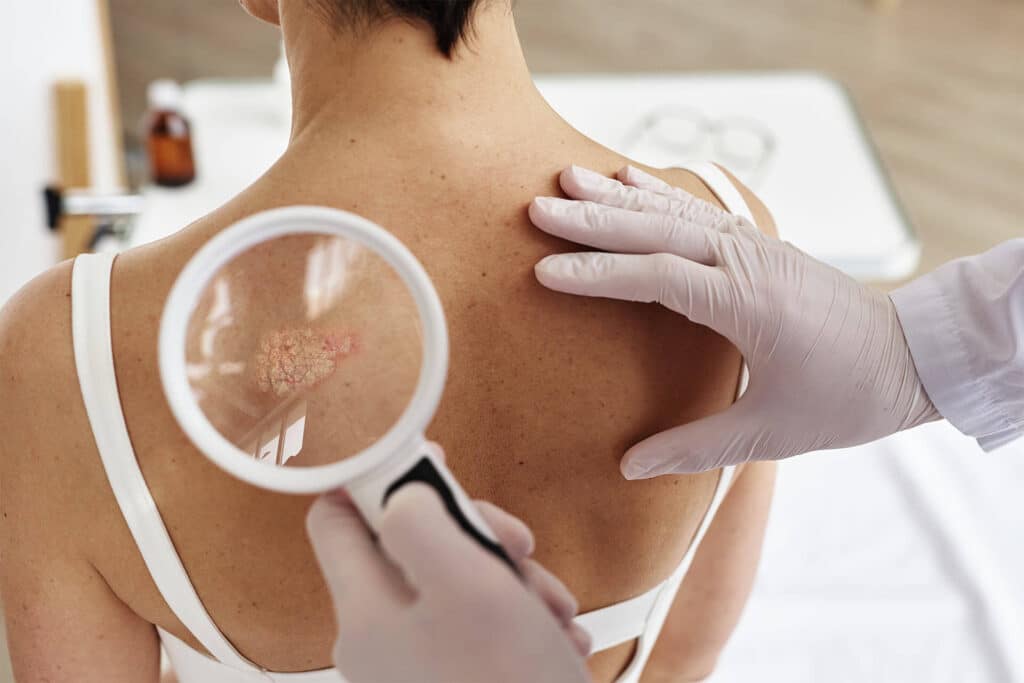
Melanoma often begins as a new mole or a change in an existing mole. Because early-stage melanoma may not cause pain or other noticeable symptoms, professional skin cancer screenings play a critical role in detection.
Our dermatology specialists perform thorough skin examinations to identify suspicious lesions and evaluate risk factors such as:
- Family history of melanoma
- Fair skin or light-colored eyes
- Excessive sun exposure
- Frequent sunburns
- History of tanning bed use
- Multiple or atypical moles
Patients who have a higher risk of skin cancer may benefit from routine screenings to help identify melanoma before it progresses.

Recognizing the Warning Signs of Melanoma
Knowing what to look for can help you seek treatment sooner. Dermatologists commonly use the ABCDE rule to identify possible melanoma:
- Asymmetry
- Border irregularity
- Color variation
- Diameter larger than 6 mm
- Evolving appearance
If you notice a mole that changes in size, shape, color, or texture, it is important to schedule an evaluation with a melanoma specialist as soon as possible.
Advanced Melanoma Treatment Options in Bensalem
At City Dermatology Skin Institute, we create individualized melanoma treatment plans based on the stage, location, and characteristics of the cancer. After diagnosis, treatment may include surgical excision, Mohs surgery in select cases, ongoing skin monitoring, or coordination with additional specialists when necessary.
Our goal is to remove cancerous tissue completely while preserving healthy skin whenever possible. Through early intervention and expert care, many patients achieve excellent outcomes and long-term skin health.
Why Choose City Dermatology for Melanoma Care?
Choosing the right melanoma specialist can make a significant difference in your treatment experience. Our practice combines advanced dermatologic expertise, state-of-the-art treatment options, and compassionate patient care.
Whether you need a routine skin cancer screening, evaluation of a suspicious mole, or treatment for confirmed melanoma, our team is committed to providing expert care close to home in Bensalem.
Melanoma Treatment Frequently Asked Questions
Melanoma is a type of skin cancer that develops in melanocytes, the cells responsible for producing skin pigment. Although it is less common than basal cell carcinoma or squamous cell carcinoma, melanoma is considered more dangerous because it can spread to other organs if not treated early.
Melanoma often appears as a new mole or a change in an existing mole. Warning signs may include uneven borders, multiple colors, increasing size, or a lesion that looks different from surrounding moles. Any changing or unusual spot should be examined by a dermatologist
Individuals with fair skin, a history of severe sunburns, excessive UV exposure, tanning bed use, numerous moles, or a family history of melanoma have a higher risk of developing the condition. However, melanoma can occur in people of all skin types.
A dermatologist typically begins with a comprehensive skin examination. If a suspicious lesion is identified, a biopsy may be performed to determine whether cancer cells are present. Early diagnosis is critical for successful melanoma treatment.
When detected early, melanoma is highly treatable and often curable. The prognosis depends on how deeply the melanoma has penetrated the skin and whether it has spread. Regular skin cancer screenings and prompt treatment offer the best chance for a successful outcome.
Most adults should receive a yearly skin examination, while patients with a personal history of melanoma or other risk factors may require more frequent screenings. Your dermatologist can recommend an appropriate schedule based on your individual risk profile.
Proudly Serving Patients Across Bucks County Townships and Northeast Philadelphia
Bucks County
Bensalem, Bristol, Feasterville, Langhorne, Southampton, Levittown, Morrisville, Falls Township, Middletown Township
Northeast Philadelphia
19154, 19114, 19115, 19116, 19136, 19152, 19111, 19149
Warminster Region
Warminster, Warrington, Warwick, Doylestown, Buckingham, Hatboro-Horsham, Abington, New Britain, Upper & Lower Moreland
References
- Zaenglein, A. L., Pathy, A. L., Schlosser, B. J., Alikhan, A., Baldwin, H. E., Berson, D. S., … & Thiboutot, D. M. (2016). Guidelines of care for the management of acne vulgaris. Journal of the American Academy of Dermatology, 74(5), 945-973.
- Lucky, A. W., Biro, F. M., Huster, G. A., Leach, A. D., Morrison, J. A., & Ratterman, J. (1997). Acne vulgaris in premenarchal girls. Archives of Dermatology, 133(8), 1041-1044.
- Layton, A. M. (2009). The use of isotretinoin in acne. Dermato-endocrinology, 1(3), 162-169.
- Hebert, A. A., Thiboutot, D. M., Stein Gold, L. F., Webster, G. F., & Leyden, J. J. (2020). Efficacy and safety of topical minocycline foam for moderate-to-severe acne vulgaris: A randomized, double-blind, vehicle-controlled study. Journal of the American Academy of Dermatology, 82(3), 832-835.
- Gold, M. H., Andriessen, A., Biron, J. A., & Garassino, M. C. (2016). Light-based therapies in the treatment of acne vulgaris. Dermatologic Surgery, 42(3), 349-357.
- Shah, S. K., Alexis, A. F., & Resh, W. (2017). Topical dapsone in acne: Overview and safety profile. Journal of Clinical and Aesthetic Dermatology, 10(1), 34.
- Fabbrocini, G., Annunziata, M. C., D’Arco, V., De Vita, V., Lodi, G., Mauriello, M. C., … & Monfrecola, G. (2009). Acne scars: Pathogenesis, classification and treatment. Dermatology Research and Practice, 2009.